Free
Document your first invention and preserve evidence.
Free
- Structured invention record
- Evidence Deposit with blockchain proof
- Certificate and public verification
- Prior Art research on the demo dataset
PatentChain turns invention work into a defensible record — timestamped evidence, patent and scholarly research, AI analysis that cites its sources, and professional review, in one structured system.
Evidence Deposit
cold-chain-disclosure-v3.pdf
SHA-256 anchored · 3 timestamp proofs
Prior art
Patent + scholarly literature
42 candidates · 6 families · 30 papers
Feature coverage
9 technical features mapped
Evidence excerpts cited per feature
Professional review
Snapshot v4 · reviewer assigned
2 issues resolved · recheck passed
Built on verifiable work, not promises
It starts as files, notes, experiments and drafts — scattered across drives, email threads, search tabs and word processors. By the time the filing question arrives, the record is fragmented and the research is hard to defend.
One invention record
PatentChain puts a structured system around that work: one record per invention, with evidence, research, drafting and review connected to it.
Every stage writes into the same invention record — so the evidence, the research and the draft never drift apart.
Create an Evidence Deposit: your documents are fingerprinted with SHA-256 and the fingerprint is anchored with independent timestamp proofs. The confidential file itself stays private.
Run prior-art research across patent literature and scholarly publications, with a transparent retrieval strategy instead of a black-box list.
Feature-level intelligence maps your invention's technical features to retrieved evidence. AI findings must cite the stored excerpts they rely on — unsupported output is rejected.
Structure claims, assemble an application draft and bring a professional reviewer into the same traceable workflow — comments, issues, rechecks and approvals on the record.
Export structured PCT, EPO or USPTO preparation packages, and keep the full history — snapshots, reports, attestations and evidence — in the Evidence Vault.
An Evidence Deposit proves a document existed in a specific form at a specific time — without publishing the document. PatentChain anchors a cryptographic fingerprint, never the confidential file itself.
Independent verification
Anyone with the certificate can verify a file against the record — without seeing its contents.
Versioned history
Each iteration becomes a new timestamped version. Nothing silently overwrites the record.
Honest status
Every proof shows its real state — anchoring in progress is labelled, never faked.
An Evidence Deposit is evidence of existence and integrity at the recorded time. It is not a patent filing, not legal priority, and not proof of ownership.
Your document
Stays private — stored encrypted, or fingerprinted in your browser and never uploaded
SHA-256 fingerprint
A canonical hash identifies the exact content
Timestamp proofs
Blockchain anchoring, OpenTimestamps and RFC 3161 where configured
Evidence record
Certificate, verification page and tamper-evident history
PatentChain retrieves real patent literature, resolves families, and maps every technical feature of your invention to evidence excerpts from the retrieved documents — so you can see the overlap, not guess at it.
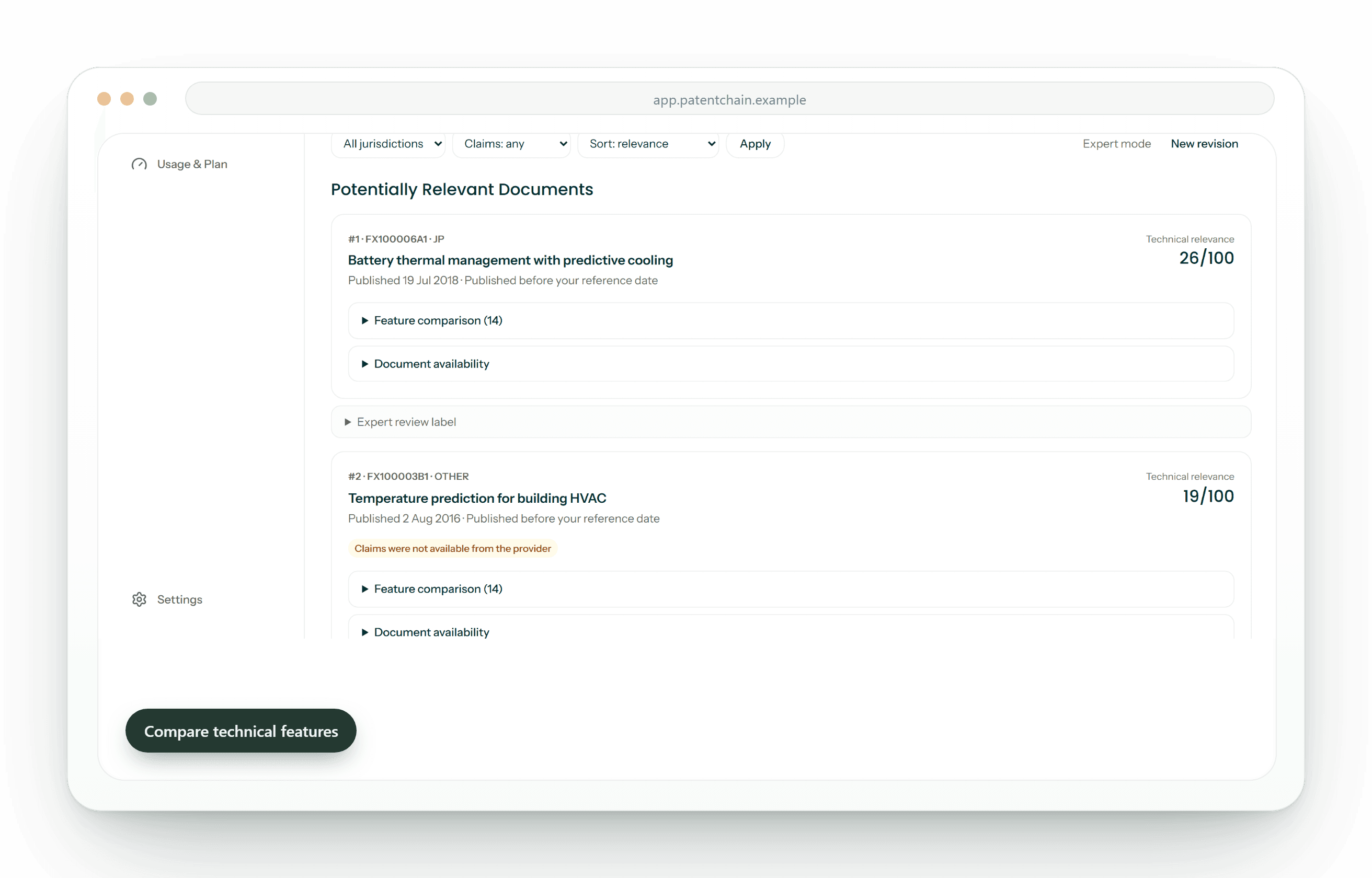
Feature coverage
Which of your features appear in the retrieved set — strong, partial or absent
Evidence excerpts
Every match points at stored source text, not a score
Patent families
Related publications grouped, not counted twice
Honest warnings
Post-reference-date and low-confidence results are flagged, never hidden
Innovation is often disclosed in journals and conference papers long before any patent. PatentChain searches scholarly literature alongside patent documents and keeps the two clearly labelled.
Prior-art research is a technical research aid. It is never a novelty determination, a patentability opinion or a freedom-to-operate conclusion.
Every AI analysis in PatentChain is grounded: findings may only reference documents and excerpts that were actually retrieved and stored. Output that cannot point at its evidence is rejected by validation — not shown to you.
Cited, not asserted
Findings carry references to the stored evidence they rely on.
Reviewable
Draft and claim suggestions are proposals — you accept or reject each one.
Fail-closed
If validation cannot verify the output against evidence, the analysis is rejected rather than displayed.
AI assists the work. It never concludes that an invention is novel or patentable, and it never replaces professional judgment.
AI finding
Feature 03 — adaptive sampling interval appears partially represented
Grounded in
Evidence excerpt · retrieved abstract, stored verbatim
Source
Patent candidate · family-resolved publication
Claim 1 · independent
A monitoring node comprising a sensor board, a classifier and an adaptive scheduler…
Support: disclosure §2, §4 · features F1–F4
Claim 2 · dependent — the classifier of claim 1, wherein…
Claim 3 · dependent — the scheduler of claim 1, configured to…
The Claim Designer structures independent and dependent claims and connects each limitation to supporting text in your disclosure. The drafting workspace assembles the application — technical field, background, summary, description, abstract, claims and drawings — as one reviewable document.
Claim structure
Independent and dependent claims with explicit hierarchy and support mapping.
Specification support
Each claim element traces to disclosure text — gaps are visible, not hidden.
Formal checks
Drafts validate against PCT, EPO and USPTO formal profiles before packaging.
PatentChain produces a working draft for you and your professional advisers. Professional review is recommended before any filing decision.
The system does not stop at AI. Invite a patent professional into the workspace: they review a bound snapshot of your application, raise issues, request changes and approve — with every step recorded.
Review requested
Reviewer assigned
Issue raised
Changes requested
Recheck
Approved
Traceable workflow
Comments, blocking issues and decisions attach to a specific application snapshot.
Reviewer attestation
An approval records who approved exactly which version — a documented professional opinion, not a certification.
AI assists. Professionals review.
PatentChain aligns with counsel instead of replacing it.
Export structured PCT, EPO or USPTO preparation packages — and keep the complete story in the Evidence Vault: application snapshots, review reports, attestations, evidence and a verifiable manifest.
A downloadable, verifiable bundle of what existed, what changed and what was approved.
Share records through private, expiring, revocable links.
Matters organize the work; operational deadlines and notifications keep it moving.
Preparing a package is not filing. PatentChain does not submit anything to a patent office — filing is done by you or your representative through official channels.
Organizations, roles and scoped access keep team workspaces controlled. Reviews, matters, deadlines and notifications turn individual invention work into an accountable process.
Roles & access
Owner, admin, member and viewer roles scope who can see and change what.
Matters
Group inventions, deposits, drafts and reviews around one protection effort.
Audit trail
Actions are recorded — who did what, and when, stays reviewable.
Every claim below maps to a shipped capability — nothing here is aspiration.
SHA-256 fingerprints, immutable artifacts and independent timestamp verification.
AI conclusions trace back to retrieved, stored evidence — unsupported output is rejected.
Organizations, roles and per-record authorization on every route.
Search strategy, provider context and analysis versions are retained for later review.
Confidential invention content is never placed on-chain — only cryptographic fingerprints are anchored.
Patent literature via EPO Open Patent Services. Scholarly literature via OpenAlex, with bibliographic verification via Crossref. Provider integrations are factual — no endorsement implied.
Inventors & founders
A defensible record before you pitch, publish or demo.
R&D teams
One standard for how inventions are documented, searched and reviewed.
Universities & researchers
Structured disclosures and evidence before the formal IP process begins.
Patent professionals
Clients arrive with a structured record, cited research and a reviewable draft.
Innovation & IP managers
Portfolio, roles, deadlines and an audit trail across the team's work.
Start free. Paid pilot access is currently activated by the PatentChain team — pricing shown for pilot access and may change before general availability.
Document your first invention and preserve evidence.
Free
For inventors documenting an active project.
€49/month
For R&D teams building a portfolio of records.
€149/month
For organisations standardising evidence and research.
€499/month
Paid-plan pricing is provisional (controlled pilot) and may change before launch.
Plan availability and limits may change during the controlled pilot · See the full pricing page
What PatentChain does — and, just as importantly, what it does not claim to do.
That a specific document existed in a specific form at a specific time. Evidence Deposits anchor a cryptographic fingerprint of your file with independent timestamp proofs. That is integrity-and-existence evidence — not ownership, not priority, and not a patent.
No. Only the SHA-256 fingerprint of your document is anchored. The fingerprint cannot be reversed into your document, and your file stays private — you can even use hash-only mode where the file never leaves your browser.
No. PatentChain prepares structured PCT, EPO or USPTO packages for review. Filing is done by you or your representative through official patent-office channels.
No — and it will not pretend to. Prior-art research returns candidates for review, and AI analysis maps evidence to features. Novelty and patentability are legal determinations for qualified professionals.
It analyzes retrieved evidence and drafts suggestions — with a hard constraint: every finding must cite stored source excerpts, and output that cannot be verified against evidence is rejected. You accept or reject every suggestion.
Patent literature is retrieved via the EPO's Open Patent Services. Scholarly literature comes from OpenAlex, with bibliographic details verified against Crossref. Sources are recorded with the results.
Journal articles, conference papers and other scholarly publications can describe technology years before any patent does. Searching only patent databases misses that. PatentChain searches both and labels them clearly.
Yes — that is the intended workflow. Invite a professional reviewer into the workspace: they review a bound snapshot, raise issues, request changes and approve, with every step on the record.
A structured export of your reviewed application aligned with a chosen route (PCT, EPO, USPTO), with formal checks against that route's formatting rules. Preparing a package is not submitting it.
A downloadable, verifiable bundle of one application's full history — documents, fingerprints, timestamp proofs, snapshots, review reports and a manifest that ties them together. Useful for counsel, diligence or your own archive.
Yes. The Free plan lets you create an account, document a first invention and create an Evidence Deposit. Paid plans add live prior-art research, reporting and collaboration capacity.
Yes, in a controlled way: paid pilot access is activated manually by the PatentChain team, and pilot pricing may change before general availability. Requesting access starts the conversation.
Nothing is deleted. Reaching a limit only pauses starting new operations of that kind until the period resets or you move to a larger plan.
No. Plan pricing covers the PatentChain workspace. Official patent-office fees and the fees of any professional you engage are separate and are never billed through PatentChain.
No. PatentChain structures the work before and around counsel — evidence, research, drafting and review. Professional legal advice stays exactly where it belongs: with professionals.
Tell us a little about what you're working on. We're onboarding inventors, R&D teams, universities and IP professionals in small groups.
PatentChain is onboarding pilot teams in small groups — inventors, R&D teams, universities and IP professionals. Tell us what you are working on.